Best Belt Sander for Home Use – A Practical Buyer’s Guide
Finding the best belt sander for home use isn’t about chasing the most powerful or most expensive tool on the shelf. Most homeowners and DIYers are simply looking for something reliable that makes everyday sanding jobs faster, cleaner, and less frustrating.
Maybe you’re refinishing an old table, smoothing rough lumber for a weekend project, or cleaning up edges after cutting boards to size. Hand sanding works… until it doesn’t. It takes time, effort, and patience most of us don’t have after a long day. That’s where a belt sander can make a real difference.
This guide is written for home users, hobby woodworkers, and casual DIYers who want a tool that’s easy to handle and practical for common household projects. We’re not focusing on professional jobsite machines or industrial-grade specs. Instead, the goal is to help you understand what actually matters when choosing a belt sander for home use — and how to avoid buying more tool than you’ll ever need.
If you want straightforward advice, honest comparisons, and clear explanations, you’re in the right place.
What to Look for in the Best Belt Sander for Home Use
Choosing the right belt sander starts with knowing how you’ll actually use it. For home projects, balance is usually more important than raw power.
Control and comfort should be high on your list. A belt sander that’s hard to manage can quickly ruin a workpiece, especially if you’re new to power sanding. Look for a design that feels stable and predictable during use.
Belt size and speed also matter. Wider belts cover more surface area, which can be helpful for larger boards, while narrower belts offer better control for detail work. Variable speed can be useful, but even a single, well-matched speed can work well for typical home tasks.
Dust collection is another key factor. Sanding creates a surprising amount of dust, and a basic dust bag or port can make cleanup much easier and keep your workspace more comfortable.
Finally, think about maintenance and setup. Easy belt changes and simple adjustments save time and reduce frustration — especially if you only pull the tool out occasionally.
The best belt sander for home use isn’t the one with the longest feature list. It’s the one that fits your projects, your space, and your experience level without getting in the way.

The Top 5 Best Belt Sanders for Home Use in 2026
Belt Sander for Home Use #1:

The SKIL 7510-01 is a belt sander that feels clearly designed with home users in mind. It focuses less on complexity and more on helping you get consistent results without overthinking every pass. One of its standout ideas is the built-in pressure control, which alerts you when you’re pressing down too hard. For DIYers, that’s genuinely useful — it helps prevent gouging the surface and reminds you to let the tool do the work.
With a 3″x18″ belt size, this model sits comfortably in the “general-purpose” category. It’s wide enough to make progress on tabletops, shelves, and boards, but still manageable for smaller projects. The auto track belt alignment helps keep the belt centered during use, which means fewer interruptions and less fiddling mid-project.
Dust control is another area where this sander keeps things practical. The micro-filtration system is designed to capture fine dust, and the tool is compatible with standard 1-1/4 inch vacuum hoses. That makes it easier to keep your workspace cleaner, especially if you’re working in a garage or basement.
This belt sander is a solid fit for homeowners tackling furniture refinishing, light woodworking, or general surface prep where control matters more than aggressive material removal.
Who it’s best for:
DIY beginners, casual home users, and anyone who wants added feedback to avoid sanding mistakes.
Notable features:

The Makita 9403 is a noticeably larger and more robust belt sander compared to typical compact home-use models. With its 4″ x 24″ belt, it’s clearly built for users who want to remove material faster and cover more surface area in less time. This makes it especially useful for bigger sanding jobs like doors, large panels, or thick solid wood pieces.
One thing that stands out is the focus on operator comfort, despite the tool’s size. The large front grip is positioned to give you better control, which matters when working on wide surfaces or longer sanding sessions. Makita also emphasizes low noise operation, rated at 84 dB, which can make a real difference if you’re working indoors or in a shared space.
Another practical design choice is the ability to sand flush to a wall using the nose and side of the sander. That’s helpful for projects where removing material close to edges or vertical surfaces is unavoidable. Internally, the labyrinth construction is designed to protect the motor and bearings from dust and debris, which aligns well with messy sanding environments.
This model is best suited for home users who regularly tackle larger woodworking or renovation projects and want faster stock removal rather than fine, delicate sanding.
Who it’s best for:
Homeowners and DIYers working on large surfaces who want quicker material removal and a stable, full-size belt sander.
Notable features:

The Metabo HPT SB8V2 sits right in the middle between compact entry-level sanders and larger, more aggressive machines. With its 3″ x 21″ belt size, it offers a good balance of surface coverage and control, making it versatile enough for a wide range of home woodworking tasks.
A key strength of this model is variable speed control. The speed dial, located at the base of the handle, lets you adjust sanding speed depending on the material or task. That flexibility is useful if you move between rough stock removal and more controlled surface work, and it can make the tool feel more manageable for less experienced users.
Visibility and handling are also clearly part of the design focus. The clear front cover helps you see the sanding area when working close to edges or surfaces, while the soft grip is intended to improve comfort during longer sessions. The flush surface design supports even sanding, especially when working across flat boards.
Dust management is handled with a left-side mounted dust collection bag, which is designed to reduce airborne particles and improve access when sanding into corners. The sander comes with a sanding belt and dust bag included, so it’s ready for use out of the box.
This model is a good fit for DIYers who want more control and flexibility without stepping up to an oversized belt sander.
Who it’s best for:
Home users and hobby woodworkers who want adjustable speed and balanced performance for varied sanding tasks.
Notable features:
-
3″ x 21″ belt – balanced size for home use
-
9 amp motor – suitable for demanding sanding
-
Variable speed dial – adjustable sanding control
-
Clear front cover – improved work visibility
-
Dust collection bag – reduces airborne particles
-
Flush surface design – supports even sanding
Belt Sander for Home Use #4:
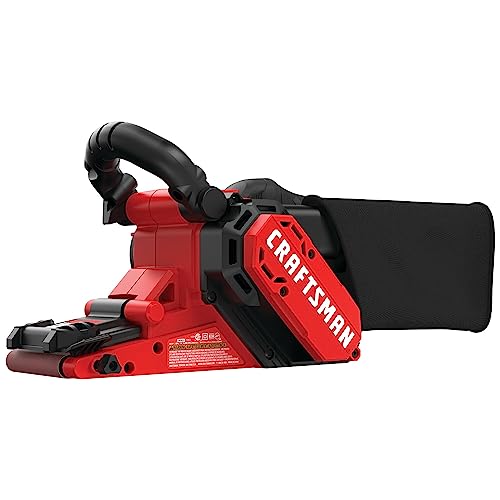
The CRAFTSMAN CMEW213 is a straightforward, no-nonsense belt sander that focuses on ease of use and everyday practicality. It doesn’t try to overwhelm you with advanced controls or complex features, which makes it appealing for home users who just want to get sanding done without a learning curve.
The 3″ x 21″ belt size is a familiar and versatile format. It’s well suited for common household tasks like smoothing boards, prepping surfaces for paint, or cleaning up rough edges. One thoughtful design detail is the angled belt, which allows you to sand closer to adjoining surfaces. That can be especially helpful when working near walls, frames, or tight transitions where a standard flat design might get in the way.
Belt changes are kept simple with a tool-free release system, making it easy to swap belts without breaking your workflow. Dust management is handled by an on-board dust bag, designed to collect sanding debris directly at the source. While basic, this setup can make a noticeable difference when working indoors or in smaller spaces.
Comfort also gets attention here. The 3-position over-molded handle gives you options for grip and control, depending on the task and sanding angle. Overall, this sander feels aimed at homeowners who value simplicity, comfort, and reliable performance over advanced customization.
Who it’s best for:
DIY beginners and homeowners looking for an easy-to-use belt sander for general sanding and surface prep.
Notable features:
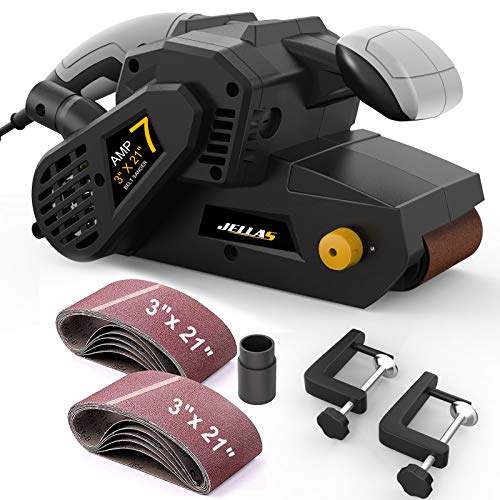
The Jellas 3″ x 21″ belt sander is designed to offer flexibility and versatility for home users who like to experiment with different sanding setups. At its core, it follows a familiar format that works well for general woodworking and surface preparation, but it adds a few practical twists that set it apart from more traditional models.
One of the defining features here is the variable-speed control, with a knob offering multiple speed settings. This allows you to slow things down for more controlled sanding or increase speed when working on rougher surfaces. For DIYers who work on a variety of projects, that adjustability can make the tool feel more forgiving and adaptable.
What really makes this model different is its 2-in-1 design. With the included metal C-clamps, the sander can be flipped over and secured to a table, effectively turning it into a bench-style sander. This can be useful for sanding smaller pieces where holding the workpiece steady is easier than moving the tool itself. A lock-on button supports longer sanding sessions by reducing the need to hold the trigger continuously.
The included sanding belts cover a wide range of grits, which helps beginners get started without immediately buying extras. Dust collection is handled by a detachable dust bag designed for easy removal and cleaning.
Who it’s best for:
DIY users and hobbyists who want variable speed control and the option to use the sander as both a handheld and bench-style tool.
Notable features:
Quick Comparison: Which Belt Sander Fits Your Home Projects Best?
If you’re trying to narrow down the best belt sander for home use, the differences mostly come down to size, control, and how much material you plan to remove.
For beginners and general home use, the SKIL 7510-01 and the CRAFTSMAN CMEW213 stand out as approachable options. The SKIL model adds extra confidence with its pressure control warning, which can help prevent mistakes early on. The CRAFTSMAN focuses more on comfort and simplicity, with an angled belt design that’s useful near edges and adjoining surfaces.
If you want more flexibility, the Metabo HPT SB8V2 and the Jellas 3″ x 21″ Belt Sander offer variable speed control. The Metabo HPT feels more traditional and balanced for varied sanding tasks, while the Jellas adds a bench-mounted option, which can be handy for smaller parts and repetitive work.
For larger projects and faster material removal, the Makita 9403 clearly plays in a different category. Its wider belt and higher sanding speed make it better suited for doors, large panels, or heavy stock removal, though it may feel like more tool than necessary for occasional projects.
Each model fits a slightly different type of home user, so the “best” choice really depends on how and how often you plan to sand.
| Product | Belt Size | Motor Power | Speed Control | Dust Collection | Best For |
|---|---|---|---|---|---|
| SKIL 7510-01 | 3″ × 18″ | 6 Amp | Fixed | Vacuum compatible | Beginners, light home projects |
| Makita 9403 | 4″ × 24″ | 11 Amp | Fixed | — | Large surfaces, fast material removal |
| Metabo HPT SB8V2 | 3″ × 21″ | 9 Amp | Variable | Dust bag | Controlled sanding, varied tasks |
| CRAFTSMAN CMEW213 | 3″ × 21″ | 7 Amp | Fixed | On-board dust bag | General DIY and home use |
| Jellas 3″ × 21″ | 3″ × 21″ | 7 Amp | Variable | Detachable dust bag | Bench & handheld sanding |
Conclusion
Choosing the best belt sander for home use doesn’t require chasing professional-grade tools or oversized machines. What matters most is how comfortable the sander feels, how well it matches your typical projects, and whether it helps you work more confidently.
Smaller, simpler models are often easier to control and more forgiving, especially for DIY beginners. Variable speed and dust collection can add convenience, but they’re only useful if they match how you actually work. Larger sanders make sense for bigger surfaces, but they can be unnecessary for light, occasional use.
Take a moment to think about the projects you’re most likely to tackle. The right belt sander should quietly support your work — not complicate it.
Out of all the models we looked at, the SKIL 6 Amp 3″ × 18″ Belt Sander ended up being our favorite in this group.
And what will be the best belt sander for home use in 2027? If you are interested in this subject subscribe us and share your opinion in a comment. Thank you!