
Can You Use an Impact Driver as a Hammer Drill? What We Need to Know First
If we’re working on DIY projects long enough, we eventually run into a situation like this:
We need to drill into brick, concrete, or masonry — but the only power tool nearby is an impact driver.
That’s when the question comes up:
Can we use an impact driver as a hammer drill?
The simple answer is no, not really. While both tools have the word “impact” in their name, they work in completely different ways. Understanding that difference helps us avoid frustration, broken drill bits, and damaged materials.
Let’s look at why these tools behave differently and what our options are if a hammer drill isn’t available.
How an Impact Driver Actually Works
An impact driver is designed primarily for driving screws and bolts.
Instead of spinning smoothly like a drill, it delivers rotational bursts of torque. Inside the tool, a hammer-and-anvil mechanism rapidly adds twisting force to help drive fasteners into tough materials.
Impact drivers are great for tasks like:
-
Driving long screws into wood
-
Installing lag bolts
-
Working with dense lumber
-
Removing stubborn fasteners
The important detail here is that the force produced by an impact driver is rotational, not forward.
That distinction matters.
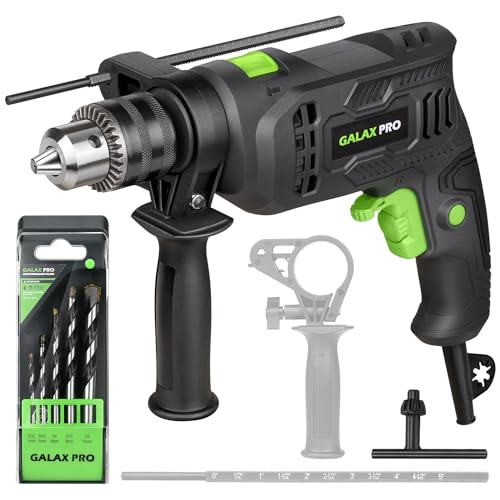
- Powerful Motor: Features a 4.5 Amps copper motor which delivers a very nice performance at 3000RPM. Providing additional durability to support overload production for drilling and chipping on wood, masonry, steel, wall, concrete and other hard materials
- 2 Functions in 1: Equipped with a green dual-mode selector on the top, you can easily switch between hammer and drill functions by one button according to various work requirements. Twelve adjustable speeds can handle different impact intensities of operation, selecting the proper from 12 sections to make the work more convenient
- 1/2 Keyed Metal Chuck: Our drill has a sturdy and durable metal chuck, its maximum chuck diameter is 1/2''. A variety of replaceable drill bits can meet the needs of different drilling materials
How a Hammer Drill Works
A hammer drill uses a completely different mechanism.
While the bit rotates, the tool also produces rapid forward hammering motions that repeatedly strike the material.
This hammering action helps break apart hard materials like:
-
Concrete
-
Brick
-
Stone
-
Masonry
The drill bit essentially chips the material while rotating, allowing it to penetrate surfaces that a regular drill would struggle with.
Without that forward hammering motion, drilling into masonry becomes extremely slow and difficult.
Why an Impact Driver Cannot Replace a Hammer Drill
Even though the names sound similar, the direction of force is different.
Impact drivers produce:
-
Rotational torque bursts
Hammer drills produce:
-
Forward hammering impacts
Because of this difference, an impact driver cannot create the pounding motion needed to break through concrete or brick effectively.
If we attempt to drill masonry with an impact driver, the result is usually:
-
Very slow progress
-
Overheated drill bits
-
Worn or broken bits
-
Frustration
The tool simply isn’t designed for that kind of work.

What Happens If We Try Anyway?
Sometimes DIYers attempt it out of curiosity.
If we try drilling into masonry using an impact driver and a masonry bit, a few things usually happen:
-
The bit spins but barely penetrates the surface
-
The bit overheats quickly
-
Progress becomes extremely slow
We might eventually make a shallow hole, but it can take far longer than using the proper tool.
In many cases, it simply isn’t worth the effort.
Situations Where an Impact Driver Can Still Help
Even though it can’t replace a hammer drill, an impact driver can still assist with related tasks.
For example:
Driving Masonry Screws
After a hole has been drilled with a hammer drill, an impact driver is excellent for installing masonry screws or anchors.
Drilling Into Softer Materials
Impact drivers can drill holes in:
-
Wood
-
Plastic
-
Thin metal
As long as we use hex-shank drill bits designed for impact drivers.
Removing Stubborn Fasteners
If we’re working on renovation projects, impact drivers are extremely useful for removing rusted or over-tightened screws.
What to Do If We Need to Drill Masonry Without a Hammer Drill
If a hammer drill isn’t available, there are a few possible options.
We can try:
-
A regular drill with a masonry bit (slow but possible for small holes)
-
Renting a hammer drill for the project
-
Borrowing one from a friend or neighbor
For occasional DIY projects, renting can be the most practical solution.

Common Tool Confusion
Many people mix up three different tools:
-
Drill/driver – general drilling and screw driving
-
Impact driver – high torque for screws and bolts
-
Hammer drill – drilling into masonry
They may look similar, but each one is designed for a different type of work.
Using the correct tool makes projects faster, safer, and much less frustrating.
Why Masonry Drill Bits Need Hammer Action
One detail many DIY beginners overlook is the design of masonry drill bits.
Unlike wood or metal bits, masonry bits don’t cut material in the traditional sense. Instead, they have a reinforced carbide tip that is designed to crush and chip hard surfaces.
When used with a hammer drill, two things happen at the same time:
-
The bit rotates
-
The drill pounds forward repeatedly
This hammering action breaks the masonry surface into tiny fragments while the rotating bit clears the debris from the hole.
Without that hammering motion, the bit simply spins against the surface. That’s why drilling into concrete with an impact driver or regular drill often feels slow and ineffective.
In other words, masonry bits rely on impact from the front — not torque from rotation.
Understanding this small detail explains why hammer drills work so much better for concrete, brick, and stone.
Conclusion
Can You Use an Impact Driver as a Hammer Drill?
-
No, the mechanisms are completely different.
-
Impact drivers deliver rotational torque, not forward hammering.
-
They are not effective for drilling into concrete or brick.
-
A hammer drill is the proper tool for masonry drilling.
-
Impact drivers are excellent for driving screws and bolts.
Impact drivers are incredibly useful tools, but they aren’t meant to replace every other power tool in the workshop.
When we understand what each tool is designed to do, we can choose the right one for the job — and that usually makes our DIY projects smoother, faster, and far less stressful.